
France and Spain are not Worlds appart
Dernière mise à jour : 23 juin

The misleading Anglo conception of “Western Europe”
In much of the Anglophere, Europe is often reduced to a simplified mental map commonly referred to as “Western Europe.” In this framework, the cultural and historical core of the continent is usually imagined as a triangle formed by the United Kingdom, Germany, and France.
These three countries are frequently thought as almost variations of a single broader « western » civilisation : described as "modern", "rational", "institutional", and somehow distinct from the rest of Europe. Americans in particular tend to assume that this « western » group of countries opposes to the latin culture of southern Europe, like the US opposes to latin America.
Within this worldview, France in particular tends to occupy an ambiguous position. Because of this association within a « core western European concept », it is often assumed as being closer to the United Kingdom or Germany than to southern Europe, sharing with it a sense of institutional modernity, secular governance, and geopolitical centrality.
By contrast, Spain, Italy, and the broader Romance world are often pushed into a totally separate mental category, described implicitly or explicitly as more “Mediterranean,” more emotional, or culturally distant from the European core.
This way of thinking produces a set of widely held assumptions that France is somehow essentially a light variation of the « western » (aka « Anglo-germanic » culture), and that Spain or Italy belong to a peripheral southern sphere, almost as if they were located outside of the « western world ».
As such it is often thought that there is a deep cultural gap between French identity and the rest of the Latin world, especially with the Hispanic world, as there is between the Anglo-word and the hispanic world. This lead a a big misundertanding of what is deeply french identity.
Many Americans who travel to the borderlands of the Pyrenees are struck by the realization that the transition between France and Spain is a fluid, organic gradient rather than a sudden "clash of civilizations."
They often describe arriving expecting to see a sharp, binary shift, a jarring transition from the French "western" world to a completely different "Hispanic" one, only to find that the region feels like a cohesive, singular entity.
Travelers frequently comment on how the architecture, the pace of life, and the local traditions seem to bleed across the border, noting that the Pyrenees do not act as a wall of separation, but rather as a shared cradle for a distinct, blended identity. This experience challenges the common American assumption that national borders are absolute cultural frontiers, revealing instead that in these regions, the local identity is far more powerful and nuanced than the geopolitical line on the map.
"I honestly thought there something separating France and Spain, or at least that they were on totally opposite sides of Europe. I never realized you could just drive from grey Paris to sunny Madrid in just a few hours driving."
"I was shocked when I crossed the border in the Pyrenees. I expected a huge change, but the architecture, the food, and even the people in southern France felt like Northern Spain. "
France and Spain: continuity rather than distance
One of the most fundamental problems with the idea of a cultural distance between France and Spain is geographical. The two countries are not separated by oceans or insurmountable barriers, but by a long and historically porous land border. Unlike the United Kingdom, which is physically isolated from continental Europe, France and Spain form a continuous territorial space across the Pyrenees.
The Pyrenees stand as an imposing natural boundary between France and Spain, a range of high mountains where jagged peaks and dizzying ridges command deep respect. Yet, far from being an impassable rampart, this massif has always served as a space for transit and exchange. Through its deep valleys, accessible mountain passes, and natural breaches, the range has fostered centuries of connection, acting as a living bridge between cultures rather than a sealed wall.
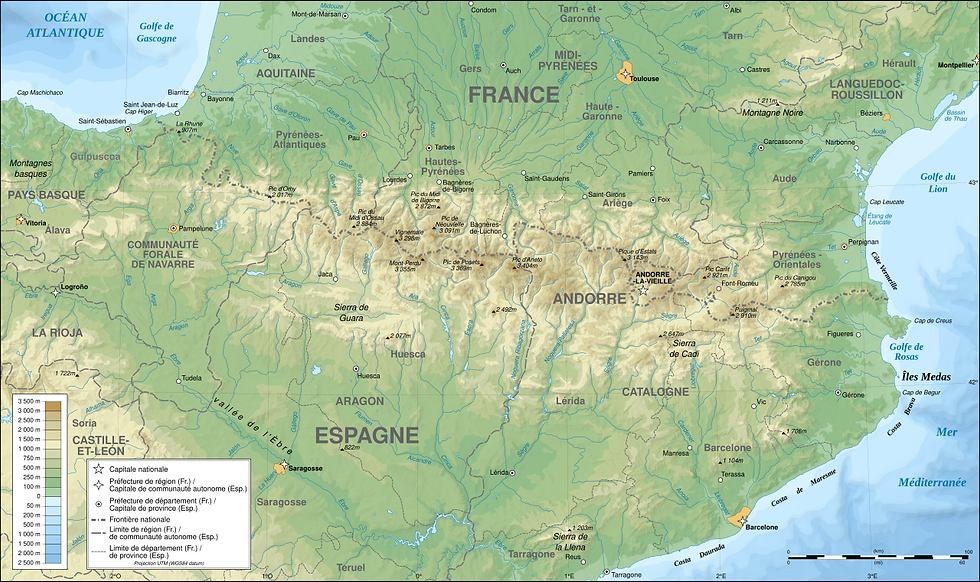

The geographic proximity between France and Spain is far tighter than many realize, fundamentally anchoring France within the broader Mediterranean orbit. Spain shares its European land border with only two nations, France and Portugal, making France its primary gateway to the rest of the continent.
This connection is not a distant, peripheral relationship but an urban reality; major French hubs like Toulouse, Bordeaux, Montpellier, Nîmes, and Bayonne are all within a three-hour drive of the Spanish border, while cities like Perpignan sit right on the doorstep.
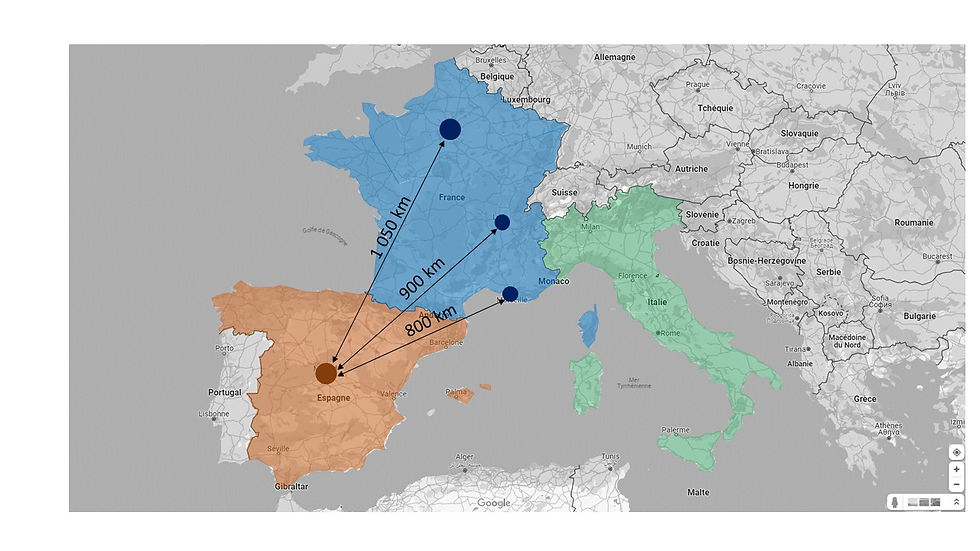
To put this into a perspective that challenges American preconceived notions of distance, Paris is actually closer to Madrid than Rome is. In a striking geographic parallels for exemple, Toulouse is twice closer to Spain than Los Angeles is to Mexico; Bordeaux is about at the same distance of Spain than Phoenix is to Mexico (180 km instead at 200 km )... And the distance from Paris, France, to the Spanish border is roughly equivalent to the distance from Paris, Texas, to the Mexican border.
Most of France, included Paris is way closer to Spain than is Italy, despite the fact that Italy is lumped with Spain in the "southern Europe concept" and France does usually not.
This realization shatters the myth that France and the Hispanic world are worlds apart, revealing instead that the two are geographically and culturally intertwined neighbors.
Far from being a rigid frontier, this border has historically functioned as a zone of transition and exchange. Across it stretch regions whose cultural identities cannot be neatly assigned to one side or the other.
The Basque Country, for example, exists as a transnational cultural space that predates modern borders. The Catalan world extends from northeastern Spain into southern France, forming a linguistic and cultural continuum rather than a sharp division. Likewise, the Occitan region of southern France shares deep historical and linguistic affinities with Iberian cultural forms.


Seen from this perspective, France and Spain do not appear as separate civilisational blocks, but rather as adjacent segments of a broader continuum. Cultural traits do not stop at the Pyrenees ; they gradually transform as one moves across the landscape. Catalan culture, in particular, can be understood as an intermediary space, linking Iberian and French Mediterranean traditions in a continuous gradient rather than a binary opposition.
Even at the level of everyday cultural practices, this continuity is visible. Festival traditions, seasonal celebrations, wine production, rural architecture, and culinary forms all display strong regional overlaps across the border.
What appears from a distance as a sharp division is, on closer inspection, a deeply interconnected cultural field shaped by centuries of exchange.
French and Spanish languages, two sister languages
French and Spanish are essentially siblings born from the same parent: Vulgar Latin, the colloquial language spoken by soldiers, settlers, and merchants across the Roman Empire.
As the empire fragmented, the Latin spoken in the province of Gaul evolved into Old French, while the Latin in the Iberian Peninsula transformed into Old Spanish (Castilian), both influenced by the local substrates of the regions they inhabited. Despite their distinct paths and evolution, they remain deeply linked.
Their shared DNA is clearly visible today in their grammatical structures, the high frequency of cognates, and the way they express complex concepts, serving as a constant reminder that both nations are fundamentally distinct, yet linguistically inseparable, branches of the same Roman family tree.
Rang | Anglais | French | Spanish |
1 | of | de | de |
2 | the | la | la |
3 | the | le | el |
4 | and | et | y |
5 | the | les | los |
6 | of the | des | de los |
7 | in | en | en |
8 | a / an | un | un |
9 | of the | du | del |
10 | to | à | a |
11 | to be | être | ser/estar |
12 | a / an | une | una |
13 | that | que | que |
14 | who/that | qui | que/quien |
15 | in | dans | en |
16 | not | ne | no |
17 | he | il | él |
18 | or | ou | o |
19 | one | un | un |
20 | which | qui | que |
21 | this/that | ce | este/eso |
22 | is | est | es |
23 | inside | dans | dentro |
24 | it | il | él |
25 | to the | au | al |
26 | on | sur | sobre |
27 | than | que | que |
28 | not | pas | no |
29 | by | par | por |
30 | for | pour | para |
31 | itself | se | se |
32 | more | plus | más |
33 | I | je | yo |
34 | his/her | son | su |
35 | she | elle | ella |
36 | all | tous | todos |
37 | well | bien | bien |
38 | it is | c'est | es |
39 | where | où | donde |
40 | to do | faire | hacer |
41 | same | même | mismo |
42 | towards | vers | hacia |
43 | most | plus | más |
44 | like/as | comme | como |
45 | whose | dont | del cual |
46 | if | si | si |
47 | their | leur | su/les |
48 | there | y | allí |
49 | that | ça | eso |
50 | these | ces | estos |
A shared historical trajectory across millennia
The depth of this continuity becomes even clearer when one considers the long historical evolution of both societies. France and Spain have not developed as isolated civilisational projects, but as parallel expressions of the same broad European-Mediterranean historical sequence.
In prehistoric times, both territories participated in some of the earliest known artistic cultures of Europe, as seen in Paleolithic cave sites such as Lascaux in France and Altamira in Spain. These are not separate cultural origins but manifestations of a shared prehistoric human environment stretching across southwestern Europe.


With the Neolithic revolution, both regions experienced similar transitions toward agriculture and settlement, integrated into wider Mediterranean networks of technological and demographic diffusion. Later, during antiquity, both Gaul and Hispania were incorporated into the Roman Empire, which remains the most decisive shared structural foundation of both societies. Under Rome, the two regions were not only politically unified but also culturally transformed through Latin language, urban planning, law, and infrastructure. The linguistic continuity between French and Spanish today is itself a direct consequence of this Romanization process.

After the collapse of Roman authority, both regions experienced comparable patterns of fragmentation and reconstitution. Germanic groups established successor kingdoms across western Europe, with the Visigoths playing a particularly important role in Iberia and the Franks shaping the future of France. In both cases, these post-Roman formations eventually evolved into Christian kingdoms structured around similar institutional frameworks.

From the medieval period onward, France and Spain developed as centralized Catholic monarchies embedded within the same Latin Christian world. Their histories remained deeply entangled through dynastic politics, warfare, and alliance systems. The early modern period in particular saw intense rivalry between the French and Spanish crowns, especially under the Habsburg system and during the reign of Charles V. Yet this rivalry itself presupposed a shared aristocratic and political culture.

Later, the Bourbon dynasties further tightened these connections, most notably with Philip V becoming king of Spain, importing French administrative and court structures into Madrid.


In the modern era, both countries have continued to evolve within the same continental framework, now expressed through the European Union, the Schengen Area, and the Eurozone. While the United Kingdom has often maintained a more ambivalent relationship with European integration, France and Spain have been structurally embedded in the same institutional project of continental unification.

Structural similarities and shared cultural frames
Because of this long shared trajectory, France and Spain exhibit profound structural similarities that go far beyond superficial cultural resemblance. Both belong to the Romance linguistic world, both emerged from Romanized territories, and both developed as centralized monarchies with strong state traditions and deep Catholic historical foundations.
Their aristocratic cultures, architectural vocabularies, and symbolic systems also draw from a shared Mediterranean inheritance rooted in classical antiquity and later refined through Renaissance reinterpretations. The result is not identity, but continuity : a shared cultural grammar expressed through different historical and national forms.
Even at the level of demographic history, genetic studies of Western Europe often show gradual variation across space rather than sharp discontinuities. The Franco-Spanish space, in particular, tends to appear as a zone of continuity rather than separation, reinforcing the idea that these populations have long shared overlapping historical and biological environments.

France and Spain within a same historical latin background
The widespread perception that France is culturally part of a « west » supposed to be closer to the United Kingdom than to Spain reflects not cultural, human nor historical depth, but modern interpretative frameworks shaped mostly by political agendas and Anglo-based media representation.
In reality, France and Spain belong to the same long civilisational continuum that stretches across the Latin West of Europe.
They are not identical, nor should they be treated as such. Each country has developed its own political structures, cultural expressions, and historical trajectories. But these differences unfold within a shared historical architecture that is far older and more fundamental than the « western european » geopolitical category as promoted by the UN, the CIA factbook, or other « official » classifications.
From this perspective, Spain is not a distant “other” to France within Europe. It is one of its closest historical neighbours, shaped by the same long processes of Romanisation, Christianisation, state formation, and cultural exchange.
Rather than belonging to separate cultural worlds, France and Spain can be understood as two closely related expressions of a single, deeply layered European historical latin-based continuum.
The two countries's parallels





Commentaires