
Why Southern France is the True Cultural Heart and Roots of France
While international travelers often view Paris, Normandy and the castles of the Loire Valley as the quintessential image of France, a deeper historical look reveals a truth that is often a blind spot for many people : the cultural, urban, and historical heart of the country beats first and foremost in the South.
Far from being a mere peripheral Sunbelt or a recent playground for tourists, Southern France is where the foundational stones of French civilization were laid.
The Historical Roots — From the Mediterranean Cradle to Roman Gaul
Long before the idea of "France" existed, the Mediterranean basin was the entry point for human civilization in Western Europe.
The Neolithic Revolution made its way through the Mediterranean shores, introducing agriculture, animal husbandry, and settled farming communities that slowly spread northward up the river valleys.

Around 600 BCE, Greek sailors from Phocaea founded Massalia, modern-day Marseille, followed by other coastal trading posts like Nicea (Nice) and Antipolis (Antibes). These were not just trading ports; they were the very first true urban settlements on French soil, introducing viticulture, olive cultivation, and urban planning.

When the Roman Republic expanded westward, they conquered this rich coastal strip connecting Italy to Spain, naming it Provincia Roman, from which the modern word Provence is directly derived. For a long time, this region was more Roman than Rome itself outside the Italian peninsula. Cities like Nemausus (Nîmes), Arelate (Arles), and Narbo Martius (Narbonne) became thriving, highly sophisticated metropolitan hubs adorned with monumental architecture.

From this Mediterranean stronghold, Roman culture did not stop at the coast. The Rhône Valley acted as a natural, wide-open highway pushing deep into the heart of the continent. Through the Rhône corridor and the routes leading toward Aquitaine, Roman laws, language—which evolved into French—engineering, and administration radiated northward.
The rest of Gaul was systematically integrated, transforming a patchwork of Celtic tribes into a deeply romanized society. This Roman culture is the base of french identity, even in the north.
Centuries later, the South continued to shape the spiritual and cultural destiny of Europe. During the Middle Ages, the Occitan cultural sphere, spanning southern France and stretching into northern Spain and northern Italy, was a powerhouse of civilization. The Troubadours and the concept of fin'amor, or courtly love, revolutionized literature across medieval Europe, laying the groundwork for modern European lyrical expression. Long before the political unification imposed by northern kings, the South was a cosmopolitan nexus bridging Latin Europe, the Mediterranean, and the wider medieval world.
Monuments of Stone — Major Ancient Vestiges in Southern France
To the eyes of many foreign tourists, France is Paris, medieval castles and gothic cathedrals; but that is just a little part of the image.
To walk through Southern France (and also elsewhere, in a leasser degree) is to walk through an open-air museum of Antiquity that rivals the best of Italy. The architectural milestones of the region bear witness to its deep Roman pedigree.
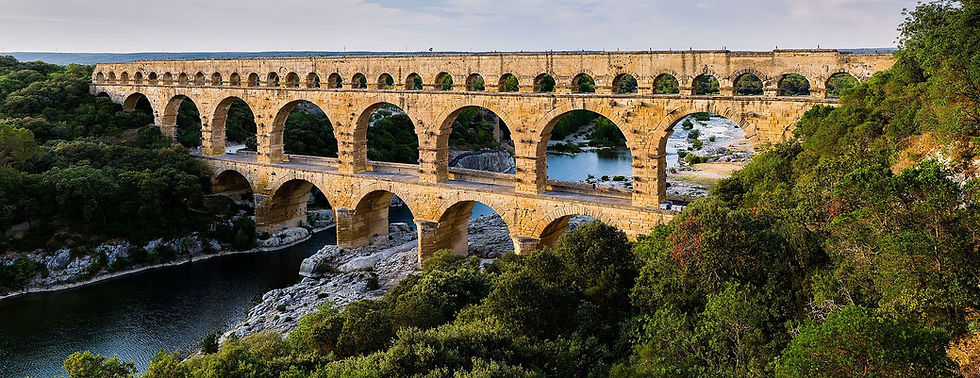
The Pont du Gard stands out immediately as an engineering marvel of the first century CE. This massive three-tiered aqueduct carried water across the Gardon River over fifty kilometers to Nîmes, and its staggering preservation illustrates the supreme mastery of Roman civil engineering.
In Nîmes also stands the Maison Carrée, one of the best-preserved Roman temples in the entire ancient world. Built around 2 to 5 CE and dedicated to the grandsons of Emperor Augustus, its pristine classical proportions so captivated American statesman Thomas Jefferson that he used it as the direct architectural blueprint for the Virginia State Capitol.


The Roman footprint also expresses itself with power and beauty in Orange, whose theatre boasts the best-preserved stage wall of any Roman theatre surviving today, evoking the grandeur of imperial entertainment.


Not far from there, in and arour Arles, often called the Rome of Gaul, featuring an amphitheater, ancient theatres, and subterranean cryptoportiques—testify to a continuous urban use spanning two millennia.


Elsewhere in the whole mediterranean regions of France, which where part of the former "Roman Provincia" is still full of Roman remains.


After Ceasar coquest of the whole of Gaul in -52, began a long lasting period of deep romanisation of the what is now France. The Roman civilisation of Gaul that had developped for a century in southern France expanded towards the north, thru the Rhone Valley, making Lyon an Viennes one of major cities the three Gauls.


Further north, in Burgondy, Autun is still full of Roman remains, doors and arenas


Or, on the west coast, in the city of Perigueux

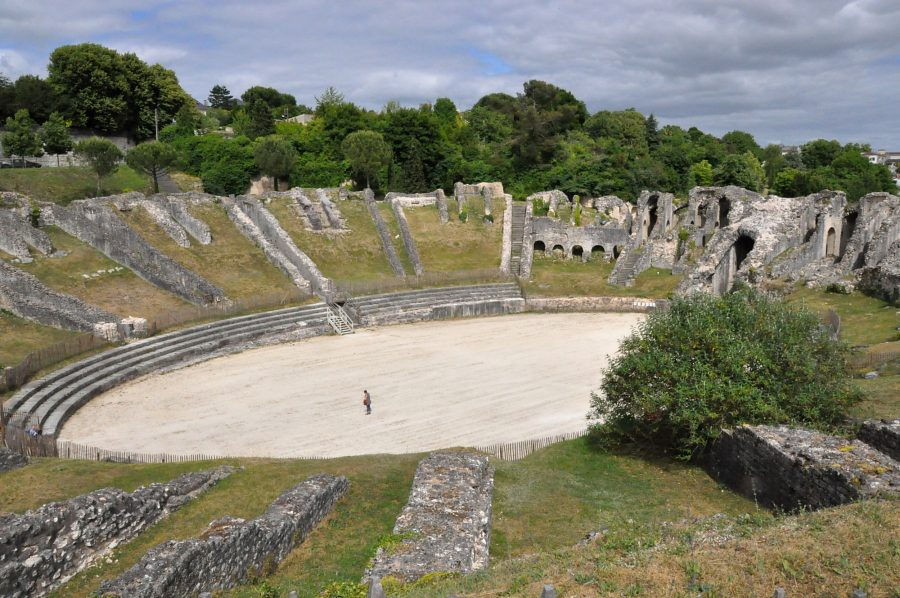
In the nearby city of Saintes


And infrastructures lefts all over the country, in Loire Valley, Champagne, Burgundy : dozens of roman bridges (lot of them still in use), piles, acqueducs...


And Paris, as the Roman baths of Cluny and the Lutece Arena


Romans gates of the city of Besançon, Reims (Champagne)


Commentaires